
Innosoft Gulf | Enterprise Agentic AI
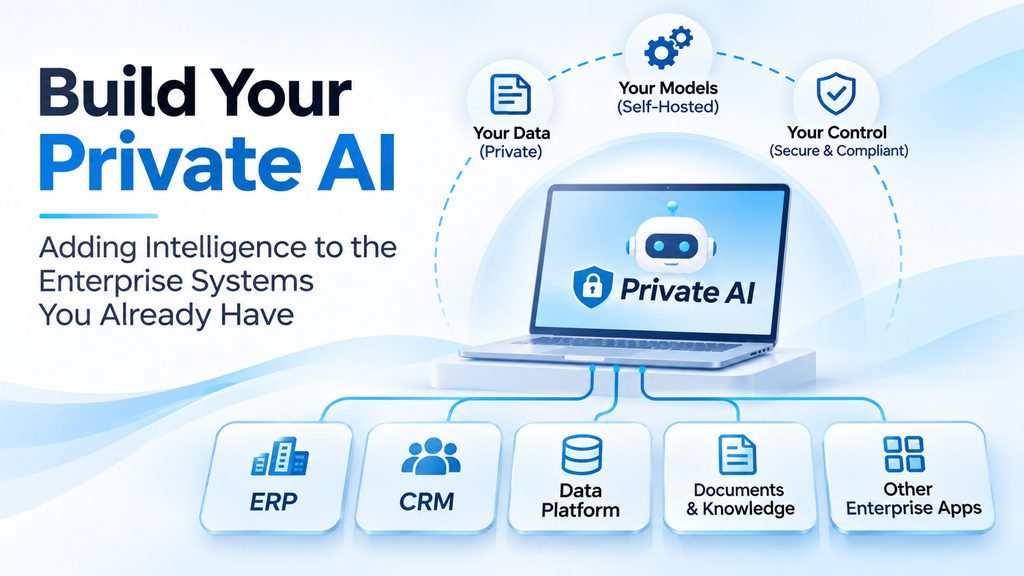
Build Your Private AI: Adding Intelligence to the Enterprise Systems You Already Have
And what exactly do we mean by private Agentic AI?
Imagine having AI agents running on your own infrastructure, securely connected to your existing enterprise systems, and capable of performing business tasks on your behalf.
These agents could retrieve information from private documents, interact with CRM and ERP systems, analyze business data, and execute authorized workflows.
And all of this could happen within an environment that you control.
What would you expect from such a solution?
For me, there are five important requirements.
1. Data Privacy
What if you could keep your business data private?
Your questions, responses, documents, and business information could be processed and stored within your own infrastructure rather than being sent to external AI providers.
This means having control not only over your AI models, but also over the systems that process and store your information.
2. Cost Control
As your business grows and more employees start using AI agents, do you want to worry about increasing token charges for every interaction?
With privately hosted language models, you can avoid external per-token API charges for the tasks handled by those models.
Running your own AI infrastructure still involves costs, including servers, electricity, maintenance, and technical support.
Private AI gives you greater control over your computing resources, operating costs, and how your infrastructure scales as demand increases.
3. Integration with Existing Enterprise Systems
Your organization probably already has CRM and ERP applications, databases, document repositories, and perhaps big data infrastructure.
Why replace these systems when you could add an intelligent AI layer that works with them?
Imagine AI agents securely accessing your CRM, interacting with your ERP, retrieving information from private documents, or working with big data platforms such as Hadoop and Spark.
These integrations can use existing APIs, workflow automation platforms, and interoperability standards such as the Model Context Protocol (MCP).
Agents should operate with clearly defined permissions, accessing only the information and functions they need.
4. Security, Observability, and Auditing
When an AI agent interacts with your business systems, how do you know what it is doing?
You need an administrative interface that allows authorized personnel to monitor agent activity, review questions and responses, track the tools being used, and examine execution results, errors, and performance.
But monitoring alone is not enough. What happens when an agent attempts to modify a financial record or approve a transaction?
Sensitive operations should require appropriate permissions and, where necessary, human approval.
AI agents must also be protected against malicious instructions hidden in documents, emails, or other information they process.
Private AI should not simply mean controlling where the models run. It should also mean controlling what the agents are allowed to do.
5. Efficient Infrastructure and CPU-Friendly Models
Do you really need expensive GPU infrastructure to begin building your private Agentic AI?
Not necessarily.
Whenever possible, I prefer smaller, CPU-friendly language models that can run on existing servers.
Some applications will need more powerful models, particularly for complex reasoning, demanding tool use, or many simultaneous users. CPU-only inference can become a bottleneck as concurrent usage grows.
A practical approach is to use lightweight models for suitable routine tasks and more capable models, sometimes with GPU acceleration, when the workload requires them.
Use the right model for the right application, while keeping infrastructure costs manageable.
From the Idea to Practical Implementation
Can we put these five requirements into practice using self-hosted technologies and openly available language models?
At Innosoft Gulf, we have been exploring this question through our own infrastructure and practical projects.
Our environment brings together several technologies:
– Ollama: Running local language models, including CPU-friendly models from the Qwen and Llama families, on our own servers.
– n8n: Automating and orchestrating workflows that connect AI agents to enterprise applications.
– Weaviate: Supporting document search and knowledge retrieval, with the option of using locally generated embeddings to maintain data privacy.
– Apache Hadoop and Spark: Our existing infrastructure for big data storage and processing.
– Vtiger CRM: An example of an enterprise application we integrate with through its APIs.
Together, these technologies provide a practical environment for exploring how AI agents can work with existing enterprise systems while reducing reliance on external AI services.
What We Demonstrated During the Training
Last week, I had the pleasure of delivering our five-day Agentic AI for Business Professionals intensive at the Innosoft Gulf Education Center in Dubai Knowledge Park.
Anthony, a product manager, travelled from Paris to Dubai to participate in this hands-on programme.
During the week, we explored how agents work with tools, how workflows connect to business systems, and how local language models can support enterprise applications.
In this article, I would like to share three practical examples we demonstrated:
1. Enterprise CRM Integration
An n8n workflow connecting to Vtiger CRM, with a working demonstration of creating an organization account through its API.
2. Private Knowledge and Document Intelligence
An AI agent for UAE Federal Tax Authority information, using Weaviate to retrieve relevant knowledge and provide context for responses.
3. Big Data Integration
A Jupyter notebook integrating Hadoop HDFS, Apache Spark, and Python tools with a locally hosted language model through Ollama, enabling users to analyze gold-trading data using natural-language questions.
Instead of replacing the enterprise systems you already have, why not build a private intelligence layer around them?
1. Enterprise CRM Integration: From Natural Language to Business Action
What if you could interact with your existing CRM system simply by asking an AI agent to perform a task?
During our training, we demonstrated exactly this using n8n, the Qwen2.5 7B language model running locally through Ollama, and Vtiger CRM.
We built an AI agent capable of interpreting natural-language instructions and interacting with our CRM through its API.
For example, we gave the agent a simple instruction:
“Create a new organization account in Vtiger CRM named Gulf Innovation Demo LLC.”
The agent interpreted the request, invoked the appropriate workflow, and created the organization account through the Vtiger API.
We then verified that the account had been successfully created in Vtiger CRM.
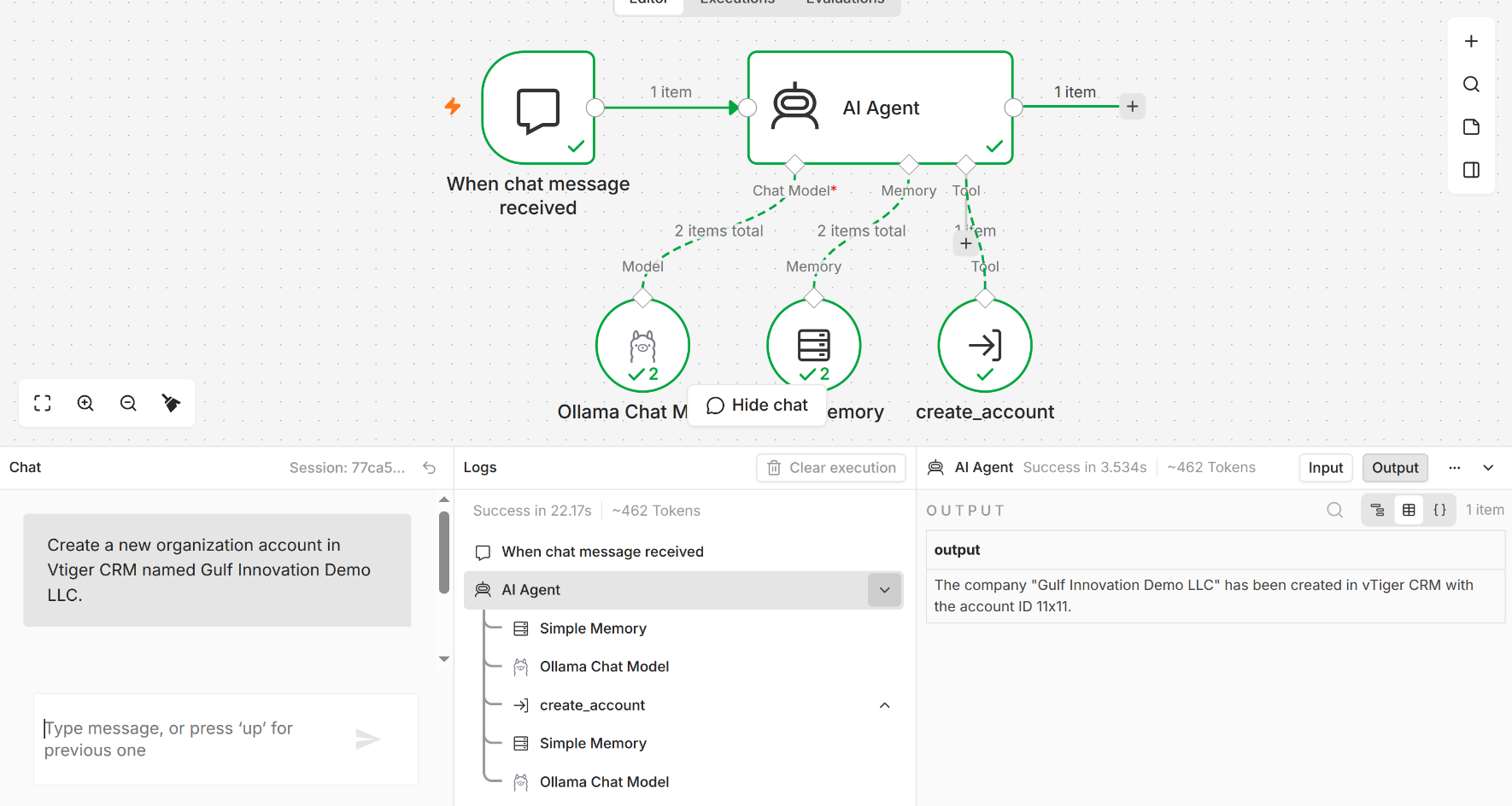
Figure 1: Enterprise CRM integration using n8n, a locally hosted language model through Ollama, and the Vtiger CRM API. The AI agent receives a natural-language instruction, executes the appropriate workflow, and creates a new organization account.
Why does this matter for enterprises?
Because Agentic AI is not just about answering questions.
With the right integrations and permissions, AI agents can perform useful business tasks directly within the enterprise systems you already use.
2. Private Knowledge and Document Intelligence: Turning Documents into Answers
What if your employees could ask questions about complex regulations, internal policies, or technical documentation and receive answers supported by relevant sources?
During our training, we demonstrated this using an AI agent built with n8n, Weaviate, and a locally hosted language model through Ollama.
For example, we asked the agent:
“What is the VAT treatment of educational services provided by training institutes in the UAE?”
The workflow retrieved relevant information from the UAE Federal Tax Authority’s VAT Education Guide using Weaviate.
The AI agent then used this information to generate a response explaining the applicable VAT treatment, with references to specific pages of the guide.
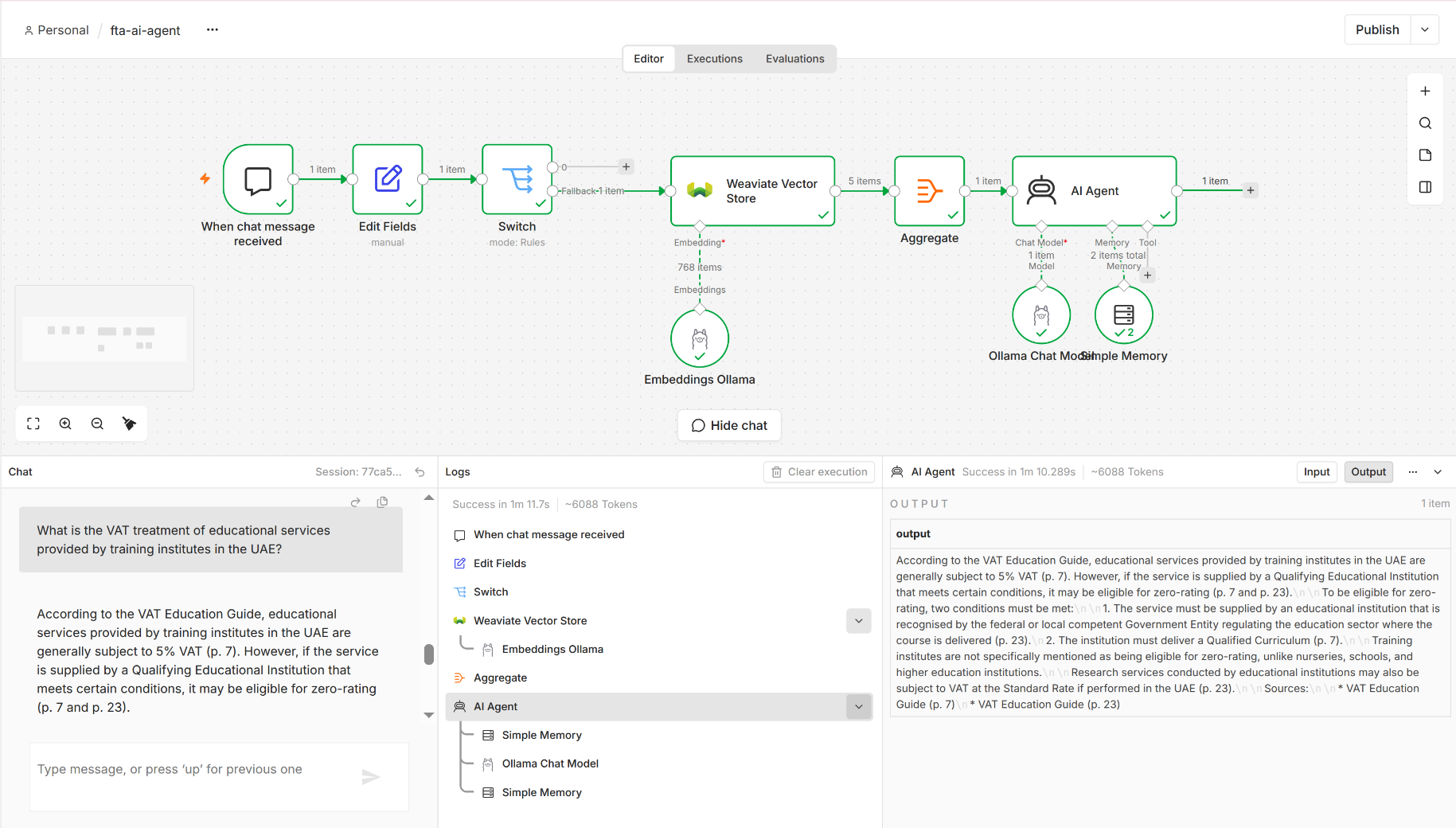
Figure 2: Private knowledge retrieval using n8n, Weaviate, and Ollama. The AI agent searches a locally managed knowledge base containing FTA documentation and generates a response supported by references to the original sources.
But couldn’t you achieve something similar using ChatGPT or Claude?
Of course. Modern AI assistants can already work with documents and local files.
The important difference in our implementation is how we organize, retrieve, and control the knowledge available to the AI agent.
We select relevant documents, divide them into smaller searchable sections, and index them in our own Weaviate vector database.
When someone asks a question, the agent searches this defined knowledge base, retrieves relevant information, and uses it to generate a response with references to the original documents.
This approach allows organizations to control which documents are included, how information is retrieved, and where the underlying infrastructure operates.
Why does this matter for enterprises?
Organizations can build private knowledge systems around their own policies, procedures, regulations, and technical documentation.
Rather than relying solely on a language model’s general knowledge, AI agents can retrieve information from a curated collection of enterprise documents.
Of course, responses still require appropriate verification, particularly for legal, financial, and regulatory matters.
The objective is not simply to generate answers, but to make enterprise knowledge more accessible, traceable, and manageable.
3. Big Data Integration: Asking Questions About Large Datasets
What if your employees could analyze large volumes of enterprise data simply by asking questions in natural language?
During our training, we demonstrated this using a Jupyter notebook connecting a locally hosted language model through Ollama to Apache Spark and Hadoop HDFS.
Our example involved Binance Futures gold-trading data (XAUUSDT) for October 21, 2026.
We provided the AI agent with three approved Python tools capable of retrieving and analyzing information from our existing big data infrastructure.
For example, we asked:
“How many gold trades occurred on October 21, 2026?”
The agent returned:
“1,217,897 gold trades occurred on October 21, 2026.”
We then asked:
“What was the largest gold trade on that day?”
The largest recorded trade had a notional value of approximately USD 4.66 million.
Finally, we asked:
“Give me a summary of gold trading on October 21, 2026.”
The underlying Spark calculations returned approximately USD 2.09 billion in total trading notional value, across 1,217,897 trades, with an average trade value of USD 1,718.44.
But how does this work?
The language model interprets the question and selects an appropriate tool. Python validates the selection, and the approved tool uses Apache Spark to perform the calculation on data stored in Hadoop HDFS.
The results are then returned to the language model, which presents them in natural language.
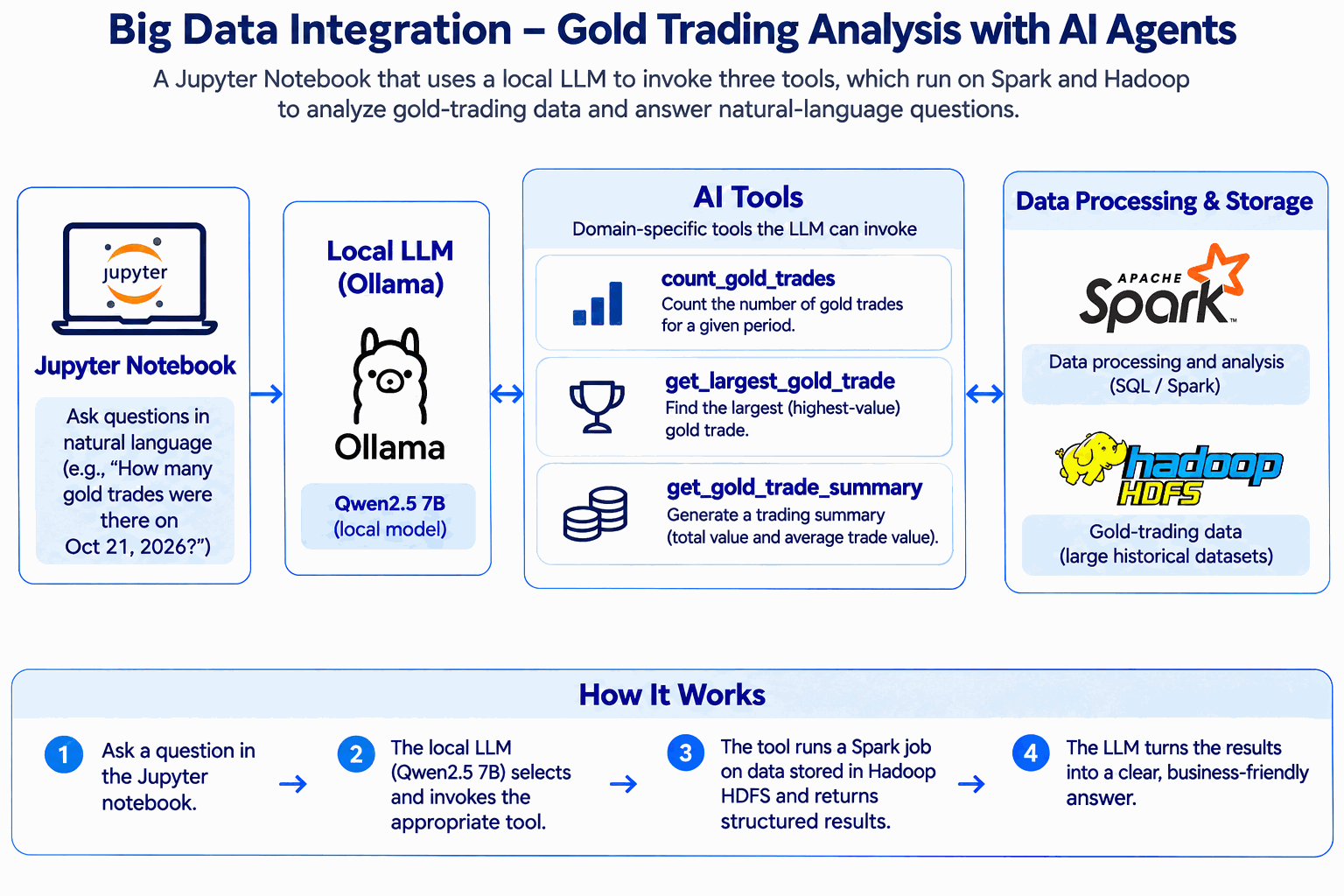
Figure 3: Private AI integration with enterprise big data infrastructure. A locally hosted language model selects from three approved tools that use Apache Spark to analyze Binance Futures XAUUSDT trading data stored in Hadoop HDFS.
Why does this matter for enterprises?
Because the language model does not need to calculate everything itself.
Instead, it can invoke approved tools that perform calculations using the organization’s existing data infrastructure.
This approach allows businesses to make large datasets more accessible without replacing their established systems or giving the AI model unrestricted access to their data.
As with any AI-generated response, numerical results should still be validated against the underlying calculations.
The objective is to combine the conversational capabilities of AI with the processing power and reliability of existing enterprise data platforms.
Conclusion: Building Intelligence Around the Systems You Already Have
The three demonstrations we’ve explored illustrate an important principle: organizations do not necessarily need to replace their existing systems to benefit from Agentic AI.
By combining locally hosted language models with controlled tools, workflow automation, and established enterprise infrastructure, we can build AI agents capable of performing business tasks, retrieving knowledge, and analyzing large datasets.
The real opportunity is not simply to deploy more powerful AI models. It is to make AI work securely, reliably, and effectively with the systems and information organizations already have.
At Innosoft Gulf, this is the direction we continue to explore: building practical, private AI solutions that add intelligence to existing enterprise infrastructure while maintaining control over data, operations, and costs.
And I’d like to leave you with a question:
If you could connect a private AI agent to one of your organization’s existing systems, which system would you choose, and what would you want the agent to accomplish?
About the Author

Ahmed El Koutbia is the Managing Director of Innosoft Gulf, a Dubai-based technology training and consulting company specializing in Artificial Intelligence, Agentic AI, Big Data, and enterprise automation. He works on practical AI implementations integrating private language models with existing business systems and data infrastructure.