
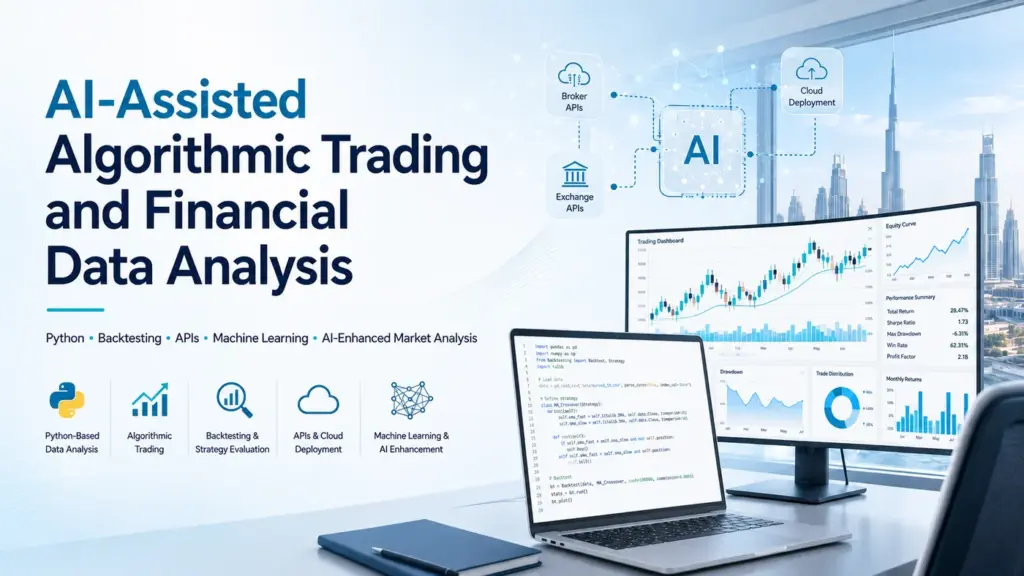
AI-Assisted Algorithmic Trading and Financial Data Analysis
Course Description
The AI-Assisted Algorithmic Trading Program is a hands-on course for traders, finance professionals and developers who want to design, test and automate systematic trading strategies with Python. You will take a strategy from raw market data all the way to a system running in the cloud.
Many traders still check charts, copy data into spreadsheets and place orders by hand. A well-designed trading system can scan markets, test ideas and execute consistently, without fatigue or emotion. In this program you will learn to collect and clean financial data, define and backtest strategies, connect to broker and exchange APIs, and deploy your system to a cloud server.
You will also see how AI is changing market analysis today, from machine learning for signal generation to language models that read news and earnings calls, and where human judgement must stay in control.
Program Schedule and Fees
The program offers 15 hours of live, instructor-led training, delivered in person at Dubai Knowledge Park or live online. Each cohort is limited to 12 participants.
| Cohort | Format | Dates | Fee |
|---|---|---|---|
| Weekend Cohort Next cohort | 6 sessions × 2.5 hours 6:00–8:30 PM GST | Sat 7, Sun 8, Sat 14, Sun 15, Sat 21 and Sun 22 November 2026 | Standard fee: USD 1,500 VAT inclusive |
| Weekday Cohort | 6 sessions × 2.5 hours 10:00 AM–12:30 PM GST | Mon 9, Wed 11, Fri 13, Mon 16, Wed 18 and Fri 20 November 2026 | |
| Intensive Cohort | 5 consecutive days × 3 hours 9:00 AM–12:00 PM GST | Monday to Friday, 23–27 November 2026 | |
| Corporate Intensive Groups of 4 or more | 5 sessions × 3 hours | Custom dates arranged with your organisation | Preferential group pricing Quoted on request |
All cohorts are available in person or live online. The Corporate Intensive is ideal for quantitative teams, finance departments and trading desks.
Email info@innosoftgulf.com or WhatsApp +971 52 351 7403 to ask about cohorts or request a corporate quotation
Who This Program Is For
This program is for people who want to move from manual market analysis to systematic, data-driven trading they can test and automate.
- Traders and investors ready to replace manual analysis with tested, automated strategies
- Finance professionals such as analysts, portfolio managers and risk professionals who want to build quantitative tools
- Data analysts who want to apply their Python skills to financial markets
- Fintech developers building trading tools or working with exchange and broker APIs
- Aspiring quantitative analysts looking for a practical foundation in backtesting and strategy design
- Corporate teams at banks, asset managers, brokerages and trading firms upskilling in Python, automation and AI
Prerequisite: Basic Python familiarity is recommended; you should be comfortable running scripts and working with data in a notebook. No advanced mathematics or finance degree is required. All trading in the program takes place in sandbox and paper-trading environments, so no real capital is needed.
Learning Outcomes
By the end of the program, you will be able to:
- Collect, clean and structure market data from APIs and web sources using Python.
- Calculate and visualise technical indicators and analyse price and volume data.
- Turn a trading idea into a rule-based strategy with clear entry, exit and risk-management conditions.
- Backtest a strategy on historical data and evaluate it with standard performance metrics.
- Connect to a broker or exchange API and place orders programmatically in a paper-trading environment.
- Deploy a trading system to a cloud server so it runs continuously without your local machine.
- Apply machine learning to financial data for signal generation and strategy improvement.
- Use AI to analyse news and other unstructured market information as an additional signal source.
Ready to Build Your Own Trading System?
November cohorts are now open. Seats are limited to 12 per cohort.
Apply Now Contact Innosoft GulfProgram Curriculum
Ten modules take you from setting up your environment through data, strategy design and backtesting to live deployment, machine learning and AI-assisted analysis.
Module 1
Environment Setup
Key Topics
- A Python environment for financial data work
- Key libraries: pandas, NumPy, Matplotlib, Requests and ccxt
- Jupyter and cloud notebook environments
- Connecting to data sources and APIs
Module 2
Financial Data Collection and Alternative Data
Key Topics
- Market data: price, volume and OHLCV from exchanges and brokers
- Alternative data: news feeds, earnings call transcripts and social media signals
- Collecting data from web sources and APIs
- Handling missing data, time zones and data quality
- Building a clean, structured dataset ready for analysis and modelling
Module 3
Financial Data Analysis and AI-Assisted Pattern Detection
Key Topics
- Exploratory analysis of price and volume data
- Technical indicators: moving averages, RSI, Bollinger Bands and MACD
- Returns, volatility and correlation analysis
- Using AI tools to surface patterns and anomalies that are hard to spot manually
- Visualising market data for insight and presentation
Module 4
Broker and Exchange API Connection
Key Topics
- Connecting to broker and crypto exchange APIs with Python
- Authenticating, placing orders and retrieving account data
- Rate limits, error handling and safe API usage
- Paper-trading and sandbox environments for testing
Module 5
Strategy Definition and AI-Assisted Hypothesis Generation
Key Topics
- Strategy types: trend-following, mean reversion and momentum
- Translating a trading idea into a systematic rule set
- Using AI to generate, screen and refine strategy hypotheses
- Entry and exit conditions, position sizing and risk management
- Common strategy-design mistakes, and where AI helps or hurts
Module 6
Strategy Backtesting and Validation
Key Topics
- Building a backtesting framework in Python
- Performance metrics: returns, drawdown and Sharpe ratio
- Overfitting, look-ahead bias, survivorship bias and data leakage
- Forward testing and walk-forward validation
- Using AI to test parameter sensitivity and stress-test assumptions
Module 7
Cloud Environment Setup
Key Topics
- Why cloud deployment matters for trading systems
- Setting up a cloud server for continuous operation
- Scheduling, logging and monitoring
- Managing credentials and API keys securely
Module 8
Trading System Deployment and AI-Assisted Monitoring
Key Topics
- Deploying your strategy to a cloud environment
- Real-time data feeds and order execution
- AI-assisted performance monitoring and anomaly detection
- Handling failures and moving safely from paper trading to live operation
- Human oversight: what AI can decide and what requires human judgement
Module 9
Machine Learning for Financial Markets
Key Topics
- Where machine learning adds real value in trading, and where it does not
- Supervised learning for price direction and signal classification
- Feature engineering from market and alternative data
- Gradient boosting and ensemble methods widely used in quantitative finance
- Evaluating ML models in a financial context
Module 10
AI-Assisted Trading: Language Models, Sentiment and Professional Practice
Key Topics
- How trading desks and quant funds are using AI today
- Sentiment analysis of news, earnings calls and social media with financial language models such as FinBERT
- Using large language models to process unstructured financial information at scale
- AI for research and idea generation, with humans accountable for risk and execution
- Limitations, explainability and governance in AI-assisted trading
Your Instructor
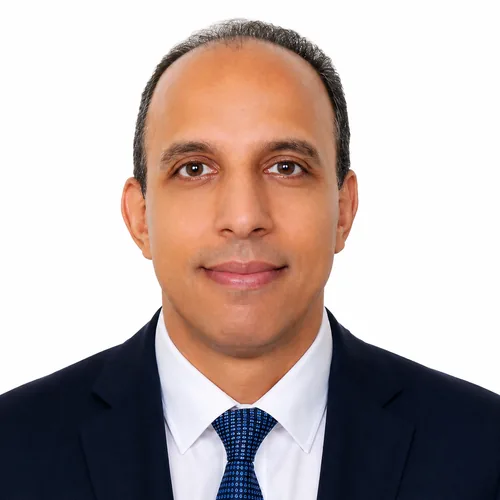
Ahmed El Koutbia
Founder and Lead Instructor, Innosoft Gulf
Ahmed began his career at the Chicago Board Options Exchange (CBOE) and has since built and deployed production trading systems and AI-driven market analysis tools. He combines deep financial-markets experience with practical software engineering, covering everything from data collection and backtesting to live API connectivity and cloud deployment.
He has delivered AI, big data and technology training to professionals from organisations including Saudi Aramco, DP World, Visa, the UAE Central Bank, Motorola Solutions, New York University and the American University of Sharjah.
Learning Experience and What’s Included
Every session is hands-on: you work with real data, real APIs and real systems from day one.
- 15 hours of live instruction in person or online, in a cohort of no more than 12.
- Safe practice environments: sandbox and paper-trading accounts throughout, with no real capital required.
- Traditional and crypto markets: broker APIs alongside crypto exchange APIs using ccxt.
- Cloud deployment guidance for running your strategy continuously.
- Certificate of Completion from Innosoft Gulf, with KHDA attestation available on request.
- Priority enrolment for the next program in the learning path.
Frequently Asked Questions
Do I need to know Python already?
Basic familiarity is recommended: you should be comfortable running scripts and working with data in a notebook. You don’t need to be an advanced programmer. The course focuses on applying Python to financial problems rather than teaching Python from scratch.
Do I need a live trading account?
No. You connect to real APIs but trade in sandbox and paper-trading environments throughout, so no real capital is required.
Does this cover crypto as well as traditional markets?
Yes. The techniques apply to both, and the API module covers crypto exchange APIs (using ccxt) alongside traditional broker APIs.
Can my organisation send a group?
Yes. The Corporate Intensive runs on custom dates for groups of four or more, with preferential pricing. Contact info@innosoftgulf.com or WhatsApp +971 52 351 7403.
Start Building Your Trading System
Join a November cohort and learn to design, test and deploy systematic strategies with Python and AI.
Apply Now Contact Innosoft GulfThis program is intended for educational and market-analysis purposes only. It does not constitute financial advice and does not guarantee trading results. Algorithmic trading and financial markets carry a significant risk of loss.