
Innosoft Gulf · Professional AI Training
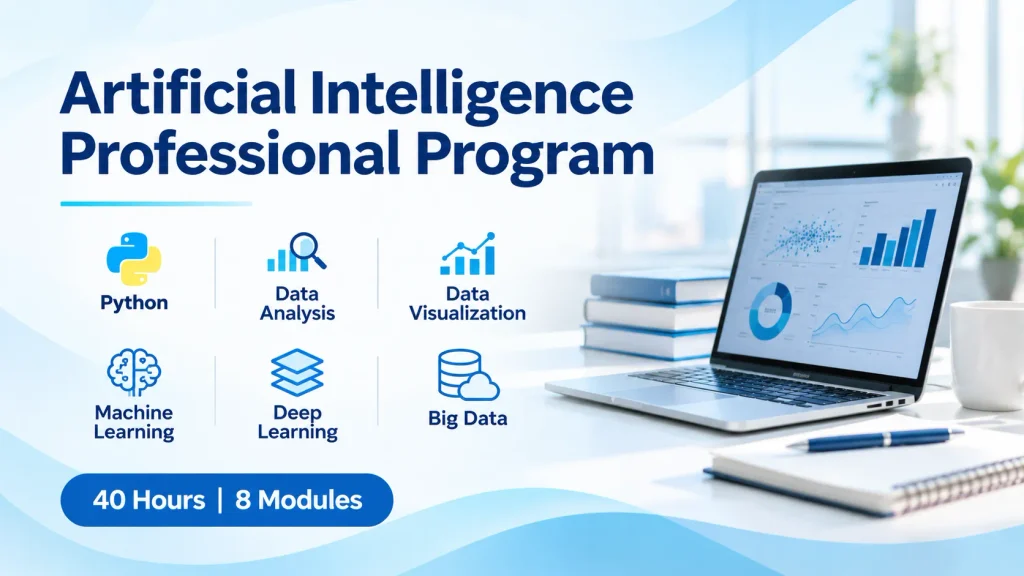
Artificial Intelligence Professional Program
From Python programming and data analysis to machine learning, deep learning, and large-scale data processing.
A practical, instructor-led program that helps professionals develop the skills to analyze real-world data, build predictive models, and understand the technologies behind modern artificial intelligence.
Course Description
The Artificial Intelligence Professional Program is a comprehensive, hands-on training program designed for professionals seeking practical foundations in Python programming, data analysis, visualization, machine learning, and modern data processing.
Participants work with real-world datasets, develop Python applications, build and evaluate predictive machine learning models, and gain introductory experience with neural networks and distributed data processing. The emphasis is on applying concepts to practical problems, not simply memorizing syntax or algorithms.
Modern AI coding assistants, such as Claude Code and OpenAI Codex, are introduced as supporting development tools. Participants learn to review, test, explain, and validate AI-generated code while building their own technical understanding.
Learning activities draw on Python, Pandas, NumPy, Matplotlib, Seaborn, Plotly, Scikit-learn, XGBoost, PyTorch, and Apache Spark. The program concludes with a performance-based practical assessment.
Program Schedule and Fees
Contact Innosoft Gulf to discuss available dates, delivery arrangements, tuition fees, and registration.
| Duration | Delivery | Location | Schedule and Fees |
|---|---|---|---|
| 40 hours | Instructor-led, hands-on | Innosoft Gulf Education Center, Dubai Knowledge Park, Block 6, Office 102, Dubai, UAE | Contact us for available schedules and fees |
Hands-On Projects and Practical Applications
Learn by working through realistic problems rather than studying theory alone.
Real Estate Price Prediction
Prepare property data, train regression models, and compare Linear Regression, Random Forests, and XGBoost to predict housing prices.
Customer Segmentation
Use K-Means clustering to identify groups in customer data and interpret meaningful differences between segments.
Handwritten Digit Recognition
Build and train a neural network with PyTorch and evaluate how well it recognizes handwritten digits.
Financial Data Analysis
Collect and examine market data, calculate statistical relationships, and communicate findings through Python visualizations.
Python Application Development
Use practical Python, functions, classes, and error handling to develop a simplified flight reservation prototype.
20-Million-Record Data Analysis
Explore large-scale data with PySpark and Spark SQL, apply distributed transformations, and summarize analytical findings.
Projects are delivered as guided exercises and applied activities; scope and complexity are appropriate to the program’s 40-hour duration.
Learning Outcomes
By the end of the program, participants will be able to:
- Write, read, and debug practical Python code.
- Use Pandas and NumPy to clean, transform, and explore datasets.
- Apply basic SQL and data visualization methods.
- Interpret descriptive statistics and analytical results.
- Build regression, classification, and clustering models.
- Evaluate machine learning models and recognize data leakage.
- Construct and assess an introductory neural network using PyTorch.
- Use PySpark and Spark SQL for guided large-scale data processing.
- Critically review and validate AI-assisted code.
Program Curriculum
Explore the eight modules. Select any module to see its topics and applied learning activities.
Module 1 — Python Programming Fundamentals6 hours
Establish a practical foundation in Python programming and learn to write, understand, and improve code for data processing and business applications.
Key Topics
- Python development with Jupyter notebooks and development tools
- Git and GitHub basics
- Data types, strings, lists, tuples, sets, and dictionaries
- Conditional statements, loops, and basic problem solving
- Reading and writing files; working with structured data
- APIs and introductory data collection
- AI-assisted coding, code explanation, debugging, and verification
Practical activities: Retrieve cryptocurrency market data using the CoinGecko API; use Python to explore the MovieLens 100K dataset and extract information from files.
Module 2 — Practical Python and Object-Oriented Programming3 hours
Move beyond basic scripts to organize reusable Python programs using functions, modules, classes, and reliable error handling.
Key Topics
- Functions, parameters, return values, and variable scope
- Introduction to classes, objects, methods, and inheritance
- Practical encapsulation and code organization
- Exception handling and debugging
- Reusable modules and introductory project structure
- Reviewing, testing, and improving AI-generated Python code
Applied project: Create a simplified Flight Reservation System prototype using Python classes, functions, and exception handling.
Module 3 — Data Analysis with Pandas, NumPy, and SQL6 hours
Learn to turn raw datasets into reliable analytical information using Python’s core data analysis libraries and introductory SQL.
Key Topics
- NumPy arrays and numerical operations
- Pandas Series and DataFrames
- Importing data, handling missing values, and cleaning datasets
- Filtering, grouping, joining, and transforming data
- Exploratory data analysis and descriptive summaries
- Introductory SQL for selecting, filtering, and aggregating records
- AI-assisted data analysis and validation of generated transformations
Practical activities: Analyze cryptocurrency correlations and volatility; explore the MovieLens dataset and a public-sector employee salaries dataset to identify patterns and prepare analytical summaries.
Module 4 — Data Visualization and Essential Statistics4 hours
Use visual exploration and essential statistical reasoning to uncover patterns and communicate clear, evidence-based insights.
Key Topics
- Choosing effective charts for different questions
- Matplotlib charts and customization
- Seaborn for distributions and relationships
- Interactive visualizations with Plotly
- Mean, median, variance, standard deviation, and distributions
- Outliers, correlation, and introductory statistical inference
- Reviewing misleading charts and validating AI-generated interpretations
Applied project: Build statistical charts and interactive visualizations using MovieLens or financial data and explain the analytical findings.
Module 5 — Machine Learning with Python10 hours
Build, compare, and evaluate predictive models using classical machine learning methods and modern tree-based ensemble algorithms.
Key Topics
- Supervised versus unsupervised learning
- Features, targets, training/validation/test splits, and preprocessing pipelines
- Linear Regression and Logistic Regression
- K-Nearest Neighbors (KNN) and Decision Trees
- Random Forests, ensemble learning, gradient boosting, and XGBoost
- K-Means clustering and customer segmentation
- Accuracy, precision, recall, F1-score, MAE, RMSE, and R-squared
- Cross-validation, overfitting, underfitting, data leakage, and introductory tuning
- AI-assisted model development, debugging, comparison, and validation
Applied projects: Compare regression models for Real Estate Price Prediction; explore Graduate School Admission Prediction with classification; apply K-Means to customer segmentation. The real estate project serves as the principal guided model-comparison activity.
Module 6 — Deep Learning with PyTorch4 hours
Gain practical introductory experience with artificial neural networks and learn how modern deep learning models are constructed, trained, and evaluated.
Key Topics
- Neurons, layers, weights, biases, and activation functions
- Forward propagation, loss functions, and the intuition behind backpropagation
- PyTorch tensors, automatic differentiation, and optimizers
- Building, training, and evaluating a feedforward network
- Training curves, test performance, and overfitting
- High-level introduction to convolutional networks and transformers
- AI-assisted PyTorch development and debugging
Applied project: Build and evaluate a Handwritten Digit Recognition neural network using a lightweight dataset and PyTorch. The practical exercise is suitable for CPU-based training.
Module 7 — Data Processing at Scale with Apache Spark4 hours
Explore distributed data processing and learn how Python workflows extend to larger datasets through Apache Spark.
Key Topics
- Single-machine versus distributed processing
- Overview of Hadoop, HDFS, Hive, and modern object storage
- CSV and Apache Parquet formats
- PySpark DataFrames, filtering, grouping, aggregation, and joins
- Spark SQL and analytical queries
- Basic data ingestion, transformation, and validation pipelines
- AI-assisted PySpark code review and debugging
Applied project: Work with approximately 20 million records in a prepared Spark environment; run selected transformations and SQL queries, validate the results, and record findings.
Module 8 — Practical Examination and Program Assessment3 hours
Demonstrate practical competence through realistic exercises, data analysis, machine learning tasks, and explanation of technical decisions.
Key Topics
- Python programming, data preparation, and visualization tasks
- Machine learning problem selection, training, and evaluation
- Interpretation of neural network results and basic Spark workflows
- Recognizing data leakage and common implementation errors
- Explaining code, model choices, findings, and limitations
- Applying the examination’s stated AI-assistance policy
Assessment: A performance-based practical examination using prepared datasets. Participants are evaluated on correctness, problem solving, interpretation, and their ability to explain and validate results.
Learning Experience and Participant Resources
Instructor-Led and Practical
Guided explanations, live coding, applied exercises, and project review. Participants work with real datasets and learn to connect concepts with practical outcomes.
Professional Tools and Environments
Jupyter notebooks and relevant Python libraries, with access to appropriate training resources and prepared environments for machine learning, deep learning, and Spark exercises.
AI-Assisted Development
Use modern AI coding assistants as productivity tools while learning to inspect code, verify assumptions, test outputs, and explain technical decisions.
Practical Assessment
Conclude with a performance-based assessment focused on demonstrated capability rather than memorization or multiple-choice answers.
Who Should Attend?
This program is suitable for professionals, analysts, developers, and technically motivated learners seeking a structured, hands-on foundation in AI and data science.
Prerequisites: No prior knowledge of Hadoop, Hive, or SAS is assumed. Basic familiarity with computers and a willingness to work with programming and data are recommended. The program begins with Python fundamentals, then progresses to more technical topics.
Frequently Asked Questions
Do I need previous Python experience?
No prior Python programming experience is required for the introductory module, although the pace is intensive. Participants should be comfortable learning technical concepts and practicing between sessions.
Will I build real projects?
Yes. The program includes guided projects and exercises across data analysis, machine learning, deep learning, and Spark, including real estate prediction and the 20-million-record analytics project.
Will I use AI coding assistants?
Yes. AI-assisted development is introduced throughout the program, with emphasis on understanding, debugging, validating, and explaining generated code.
Is a GPU required for deep learning?
No. The introductory PyTorch project is designed to use a lightweight dataset and can be completed using CPU-based training.
How are participants assessed?
Assessment is practical and performance-based. Participants demonstrate their technical understanding through hands-on tasks, model evaluation, and explanation of their solutions. Applicable AI-tool rules are communicated before assessment.
How can I confirm the schedule and fee?
Contact Innosoft Gulf for current availability, delivery arrangements, tuition fees, and registration information.