
Innosoft Gulf · Artificial Intelligence · Agentic AI Pathway
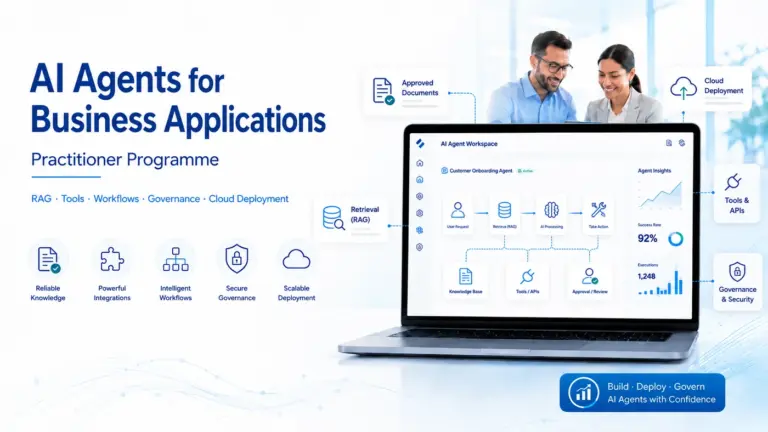
AI Agents for Business Applications
Build practical AI agents using Python, open-source language models, private business data, tools and controlled workflows
Course Description
This practical programme teaches participants how to design, build and deploy AI agents that can work with private business information, use software tools and interact with APIs, databases and other systems.
The programme builds directly on the Python Programming Foundations course. Participants use their existing Python skills to work with open-source language models, structured outputs, tool calling, Retrieval-Augmented Generation (RAG), multi-step workflows and controlled business actions.
Throughout the programme, participants progressively build a working AI agent and learn how to make it reliable through validation, human approval, logging, evaluation and deployment controls.
Course Information
| Level | Intermediate |
| Duration | 15 hours · 6 instructor-led sessions · 2.5 hours per session |
| Target audience | Developers, analysts, engineers and professionals who want to build practical AI agents |
| Development environment | Python 3, JupyterLab, Visual Studio Code, Git, Ollama and open-source language models |
| Prerequisites | Python programming skills equivalent to the Innosoft Gulf Python Programming Foundations programme |
Learning Outcomes
By the end of the programme, participants will be able to:
- Run and use open-source language models locally.
- Build Python-based AI agents with structured outputs and tools.
- Connect agents to private documents, APIs and databases.
- Build Retrieval-Augmented Generation applications.
- Create multi-step and stateful agent workflows.
- Apply validation, permissions and human approval.
- Evaluate agent reliability and identify failure modes.
- Deploy and demonstrate a working AI agent.
Session 1 · 2.5 Hours
Open-Source Language Models and Agent Foundations
- From chatbots to AI agents
- Agent architecture: model, tools, state and actions
- Open-source versus hosted language models
- Running local models with Ollama
- Introduction to llama.cpp and local inference
- Connecting Python applications to local models
Session 2 · 2.5 Hours
Structured Outputs, Tools and Agent Actions
- Structured and schema-based model outputs
- Function calling and tool calling
- Defining tool inputs and outputs
- Model-driven tool selection
- Executing Python functions safely
- Separating model decisions from deterministic execution
Session 3 · 2.5 Hours
Private Knowledge and Retrieval-Augmented Generation
- Retrieval-Augmented Generation architecture
- Document ingestion and chunking
- Local embedding models
- Vector search and pgvector concepts
- Retrieval and context construction
- Grounded answers, citations and retrieval quality
Session 4 · 2.5 Hours
Business Systems and Multi-Step Agent Workflows
- Connecting agents to APIs and databases
- Combining private documents with structured business data
- Read-only versus modifying operations
- Introduction to Model Context Protocol (MCP)
- Stateful and multi-step agent workflows
- LangGraph fundamentals and workflow control
Session 5 · 2.5 Hours
Reliability, Human Approval and Evaluation
- Validation and agent safeguards
- Permissions and controlled actions
- Human-in-the-loop approval
- Error recovery and audit logging
- Agent evaluation and test cases
- Failure analysis and systematic improvement
Session 6 · 2.5 Hours
Deployment and Final Agent Project
- Model-server and application architecture
- API and web-based agent services
- Docker deployment concepts
- Persistent databases and vector storage
- Privacy and local deployment
- Monitoring, logging and operational considerations
What You Will Build
Each participant progressively develops a working AI agent based on a practical business, professional or organisational use case.
Depending on the project, the agent may work with private documents, databases, APIs and Python tools and may be demonstrated through a web application, API or conversational interface.
Example Agent Projects
- Private company knowledge assistant
- Contract and document analysis agent
- Customer enquiry or support agent
- Business research and reporting agent
- Financial data analysis or monitoring agent
- Business workflow and approval agent
Training Methodology
Instructor-Led
Technical explanations, architecture discussions and live agent development.
Hands-On Labs
Practical work using Python, open-source models, APIs, databases and agent workflows.
Private AI Infrastructure
Access to Innosoft Gulf infrastructure for model, retrieval and agent exercises.
Project-Based
Participants progressively build their own AI agent throughout the programme.
Participant Testimonials
Feedback from participants in Innosoft Gulf Agentic AI and related AI training programmes.
“If you want to master AI agents, Innosoft’s AI Agents for Business Applications programme is the real deal. The progression from core basics such as RAG to complex workflows is incredibly well structured. They do not just teach theory. Innosoft provides a high-performance platform and JupyterLab environment for hands-on practice.”
Eureka Ilunga
Software Engineer
“Great courses with plenty of real-world examples and hands-on labs. The Agentic AI training was engaging, practical and well structured. Ahmed explains challenging concepts clearly and creates a positive learning atmosphere.”
Paulo Araujo
Data Science Professor
“It was a very practical course that provided a clear understanding of how Agentic AI works. I really appreciated the course and I am glad I attended it.”
Veena Hingarh
Bank Director
Progression Path
Participants who complete this programme will be prepared to progress toward more advanced multi-agent systems, enterprise AI integrations, private AI applications and production agent infrastructure.
Innosoft Gulf · Dubai Knowledge Park · AI Agents for Business Applications